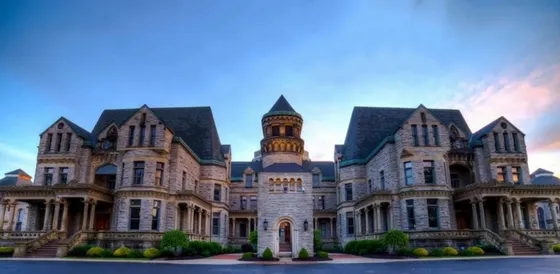
By Becky McKinnell – Archivist / Historian at Ohio State Reformatory
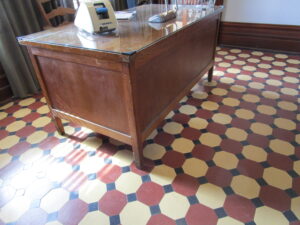
“The vestibules, halls, & passage ways of the front buildings will be laid with a neat but plain pattern of Zanesville encaustic tiles. The front vestibules may be of a handsome pattern, but all of the rest will be of alternate octagons of buff & red with black square dots & a 6” black border.” (Specifications for Ohio Intermediate Penitentiary AKA OSR) Not only were the floors of the Reformatory Zanesville tiles, but also the glazed tiles around the fireplaces and exterior vestibules at the side entrances of the Reformatory. 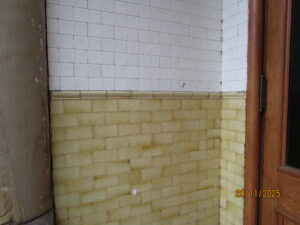
But this isn’t just a story of tile but of economic impact; not just for one town but two! Former Pres. R.B. Hayes attended the laying of the cornerstone in 1886 of the then-called Ohio Intermediate Penitentiary. Mansfield had lobbied aggressively to have the Intermediate Penitentiary built in Mansfield because of the jobs & demand for materials that would give a huge boost to the local economy.
Gov. William McKinley was on hand for the opening of a new plant in 1892 in Zanesville, Ohio, for the production of tile.
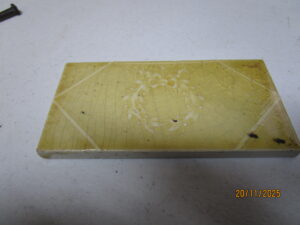
Although the American Encaustic Tiling Co. was headquartered in New York, Zanesville passed a $40,000 bond to purchase land for the factory. As a result, the company built the plant in Zanesville instead of New Jersey as originally planned. The town’s population almost tripled over a 30-year period as people found work with the company (Wikipedia). The factory ultimately closed in 1935, a victim of the Great Depression (Tile Heritage Org.), but its amazing tiles can still be seen at the Ohio State Reformatory and in the movie The Shawshank Redemption.
 An inmate once shared with me that he didn’t realize The Shawshank Redemption had been filmed at OSR until he saw the floor tiles. Zanesville still maintains pottery and stoneware production, though not at its 19th-century level. These floor tiles are a lasting link between Mansfield and Zanesville, still greeting OSR visitors every day.